
MOUNT LONGONOT NATIONAL PARK
Welcome to Mount Longonot National Park, one of the smallest national parks in Kenya, covering an area of only 52 km² in Kenya’s Great Rift Valley region. Mount […]
Welcome to Mount Longonot National Park, one of the smallest national parks in Kenya, covering an area of only 52 km² in Kenya’s Great Rift Valley region.
Mount Longonot National Park, which is protected by the Kenya Wildlife Service, was established in 1984. It is famous for Mount Longonot, a dormant stratovolcano with a large crater forest and a scenic valley that will make you appreciate the beauty that nature gives.
Mt. Longonot, which is the main attraction in the park, is said to have last erupted in the 1860s.
The park’s name, “Longonot,” is derived from the Maasai word Oloonong’ot, which means “mountains of many steep ridges or many spurs.”
It offers scenic views of Hell’s Gate National Park, Lake Naivasha, the Great Rift Valley, and many other attractions that make it a sheer adventure for tourists on a Kenya safari.
Location of Mount Longonot National Park
National Park Mount Longonot is located southeast of Lake Naivasha in Nakuru County, within Kenya’s Great Rift Valley.
It lies approximately 90 kilometers northwest of Nairobi, the capital of Kenya, and it can be accessed by road from the Nairobi-Nakuru highway.
Geography of Mount Longonot NP
The geography of the park is defined by the V-shaped valley, steep and rugged volcanic slopes, and a high elevation summit at 2,776 meters (9,108 feet) above sea level.
The summit of the mountain features a large 8X12 kilometer caldera, formed by pyroclastic flows 21000 years ago.
The caldera contains a thick forest, and the peak also offers breathtaking panoramic views of the nearby Naivasha Town, Hell’s Gate National Park, Lake Naivasha, and other surrounding landscapes.
The Park’s Weather and Climate
The park’s weather conditions are hot and dry, and the temperature ranges from 20°C to 30°C. The average annual rainfall received is about 450 mm, with the highest of approximately 700 mm and the lowest of 200 mm.
Tourist Attractions in Mount Longonot National Park in Kenya’s Great Rift Valley
There are many tourist attractions within the park, among them include;
Mount Longonot
Mount Longonot, which is the main attraction, is a stratovolcano located southeast of Lake Naivasha in the Great Rift Valley of Kenya, and its last eruption happened around the 1860s.
On an excellent day trip, the volcano offers challenging hikes up to the crater rim because of its steep slopes, but most hikers focus on the sheer adventure of the expedition rather than its occasional hardship.
The Crater Rim of Mount Longonot
Reaching the crater rim offers a moment of sheer adventure, as hikers are rewarded with great views of the geothermal steam coming out from the cracks.
Plunging into the peak’s caldera requires permission from park rangers and a guide, as the trails are unmarked and potentially dangerous.
Wild Animals
Mt Longonot National Park is home to various wild animals, including buffalo, giraffes, baboons, leopards, zebras, monkeys, and various species of antelopes, including Grant’s gazelles and elands, among others.
Bird Species
The park is known for its diversity of birds, with over 100 recorded species, including several raptors like the Verreaux’s Eagle and Lammergeier.
Other birds include the Pied crow, Red-winged starling, Superb starling, Red-eyed dove, Abyssinian wheatear, Variable sunbird, Cape robin-chat, Ring-necked dove, Nyanza swift, Nubian woodpecker, Chinspot batis, Yellow-breasted apalis, and Sentinel lark, among others.
Things to Do in Mount Longonot National Park
There are numerous things to do while on a Kenyan safari in this park, among them include
Mountain Climbing
Mountain Longonot offers one of the best mountaineering experiences to tourists on mountain climbing safaris in Kenya. The trailhead for this mountain is right behind the informational center, and it is about 3.1 kilometers when ascending to the crater rim.
The slopes of the peak are considered steep; however, the difficulty in levels of hiking the peak ranges from moderate to advanced. The first part of the trail is fairly wide and flat before becoming steep.
Though the mountain has steep slopes, it is a sheer adventure for those who trek to the summit after conquering the steep and rugged terrain.
Climbing is sheer adventure, given the expansive views of the Great Rift Valley and other surrounding landscapes and lakes, like Lake Naivasha, from the summit.
Hikers are recommended to carry at least 2 liters of water for hydration during the strenuous climb, which is about a 6 km round trip. It is advisable to start climbing between 7:00 AM and 9:00 AM to avoid the intense heat. Visitors are also advised to come early to avoid crowds on the trail.
Wildlife Viewing
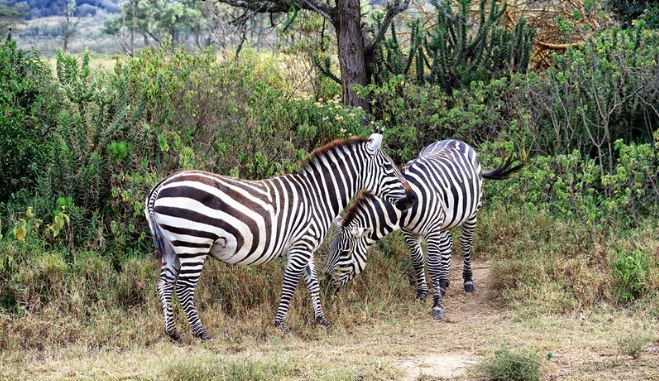
Visitors to the park have an opportunity to spot numerous animals that call this park their home. Among the commonly spotted animals on a Kenya wildlife safari to this park are zebras, baboons, buffalo, and several antelopes, among others.
Bird Watching
Mt. Longonot National Park is a birder’s haven, and bird watching can be done in any area of the park, especially when on Kenya birding safaris, offering opportunities to travel to see numerous bird species, especially on the crater rim through the crater forest.
Among the birds to see are the Variable Sunbird, Cape Robin-Chat, ring-necked dove, Nyanza swift, Nubian woodpecker, Chinspot batis, and others.
Mountain Biking
Tourists still engage in cycling to different parts of the park, where they can spot some animals along the cycling tracks.
For a taste of sheer adventure, participants can take the 2-kilometer circuit road that leads directly toward the awe-inspiring natural wonders of the lava flow.
They can also ride through communities near the park, where they witness the way of life of the locals.
Camping
Camping is another popular activity for those visiting the park. Public campsites are available near the park entrance or, with special permission, inside the mountain’s basin for a taste of sheer adventure.
Public campsites do not require prior booking, but special campsites inside the mountain caldera require a reservation for exclusive use.
Olongonot Campsite is located just inside the park entrance along the access road to the mountain crater.
Mount Longonot National Park Entrance Fees
Different entrance fees are charged for different visitors to enter the park, and the entry fees are valid for 24 hours only.
| Foreign Non-Resident | Foreign Resident | East African citizen | |||
| Adult
USD |
Child
USD |
Adults
KSH |
Child
KSH |
Adults
KSH |
Child
KSH |
| 26 | 17 | 300 | 215 | 300 | 215 |
Accommodation Options Near Mt. Longonot NP
There are no lodge accommodation facilities inside the park; however, there are a variety of accommodations available in the nearby town of Naivasha.
Accommodations include Lake Naivasha Sopa Resort, which is just 13 km from the park; Kedong Ranch House, Triple Eden Naivasha, Firebird Inn, Eldama Lodge, Escarpment Motel, and Sapphire Resort, among others.
Best Time to Visit Mount Longonot National Park
Dry Season
The park is open all year round, but visiting it is more popular during the dry season that runs from January to March and July to October.
During this time, the roads leading to the park are passable, and mountain hiking trails are dry, making it easy to hike to the summit.
Wet Season
Some tourists may visit the park during the wet season because of the low discount on accommodation options, and it is good for those who want to tour with fewer crowds. However, the hiking trail may be slippery, which may affect climbing up the volcano.
How to Get to Mount Longonot National Park?
This safari park is accessed by both road and air transport.
By Air Transport
Visitors to National Park Mount Longonot enter Kenya through Jomo Kenyatta International Airport, from where they can use a chartered or domestic flight to Green Park Airstrip. From this airstrip, visitors travel by road to the park headquarters.
By Road Transport
Mount Longonot National Park is easily accessible through a tarmac road from Nairobi city, 90 km on the Nairobi-Nakuru highway, and you can choose either to use a private or public means of transport, and the drive takes 2 to 3 hours.
Public transport options to the park include a matatu to Naivasha Town. From Naivasha, you can take a taxi or boda, which are available to take you to the park. These public transport options from Kenya’s capital to Naivasha cost between 200 and 300 KSH, and a ride from Naivasha takes about 45 minutes.
Private taxis are recommended for efficient travel from Nairobi to the park.
Packing List for a Safari in Mount Longonot NP

When planning to travel, it is essential to pack the following in your travel bag:
. Casual light clothing
- Warm clothes, like sweaters, for the cooler mornings and evenings.
- Long-sleeved shirts and long trousers
- Sturdy, grippy hiking boots to ease climbing on the steep, loose, and sometimes slippery terrain of the peak.
- A hat with a wide brim and sunscreen to protect you against the intense midday heat, especially when climbing.
. Plenty of water and snacks for the hike
- Sunglasses
- DEET insect repellent
- Torch
- Camera and extra batteries
. Binoculars to spot wild animals and birds from afar.
- Charger and extra battery, and a power bank for extra battery life
- Small day backpack
. Travel documents, like a valid visa and a vaccination certificate for yellow fever.
Mount Longonot National Park FAQs (Frequently Asked Questions)
-
How Long Does It Take to Climb Mount Longonot?
Climbing Mountain Longonot is a sheer adventure, and the average time it takes to climb the mountain, which is 2,776 meters above sea level, including the ascent, the descent, and moving around the crater rim, is about 4 to 6 hours, depending on one’s fitness.
-
Do You Need a Guide for Mount Longonot?
A guide is not necessarily needed since the pathway is properly marked; however, the local guides from the Kenya Wildlife Services are available at the park to help the less experienced hikers, and climbing to the summit is a sheer adventure since it provides valuable insights into the mountain’s geology and wildlife.
-
What Are Some Interesting Facts About Mount Longonot?
- The name for Mt. Longonot is derived from the Maasai word Oloonong’ot, which means “mountains of many steep ridges or mountains of many spurs.”
- It is a dormant volcano that last erupted in the 1860s. The presence of active magnetic systems beneath the range has been recorded, and hikers can still see some small geothermal steam inside the mountain basin.
- There is a thick forest that grows on the crater floor of the mountain, and every step promises sheer adventure and the thrill of the unknown.
- It was formed by volcanic activities about 400,000 years ago, and its large caldera was formed from the massive eruption of lava approximately 21,000 years ago.
- It offers unique geological features, which include basalt columns.
-
How Far Is It Around Mount Longonot Crater?
The hike around the rim of the basin is approximately 13.5 km, and the round-trip hike from the park entrance to the Longonot range and back takes around 4 to 5 hours to complete.
-
When Was the Last Time Mount Longonot Erupted?
Mount Longonot, which is an extinct volcano, last erupted in the 1860s.
-
What Is Found in Mt. Longonot?
Mountain Longonot, located in Nakuru County in Kenya’s Great Rift Valley, contains a basin with a small forest, unique volcanic rock, and small steam vents. It is also home to numerous bird species and some wild animals.
Conclusion
Given the perfect location of Mount Longonot National Park in Kenya’s Great Rift Valley, its numerous attractions, and interesting things to do, it remains the best place for adventure seekers and nature enthusiasts on a Kenyan safari. With accommodation options provided, the packing list, what to wear, and how to reach the park, do not hesitate to book your memorable safari